
JOURNAL
A Bright Room Is Not a Well-Lit Room
· Enzo Laboratory

Lighting can completely transform an interior, yet it is often treated as an afterthought. A room is designed, furniture is selected, artwork is hung—and then someone looks at the ceiling and decides a grid of recessed lights should take care of everything.
It will certainly make the room bright. But brightness alone is not lighting design.
At the other extreme, relying on a single fixture in the center of the ceiling leaves corners in shadow and everything beyond its reach feeling gloomy. Good lighting exists somewhere between these extremes. It comes from multiple sources, at different heights and intensities, each serving a purpose.
Good lighting lets a room breathe.
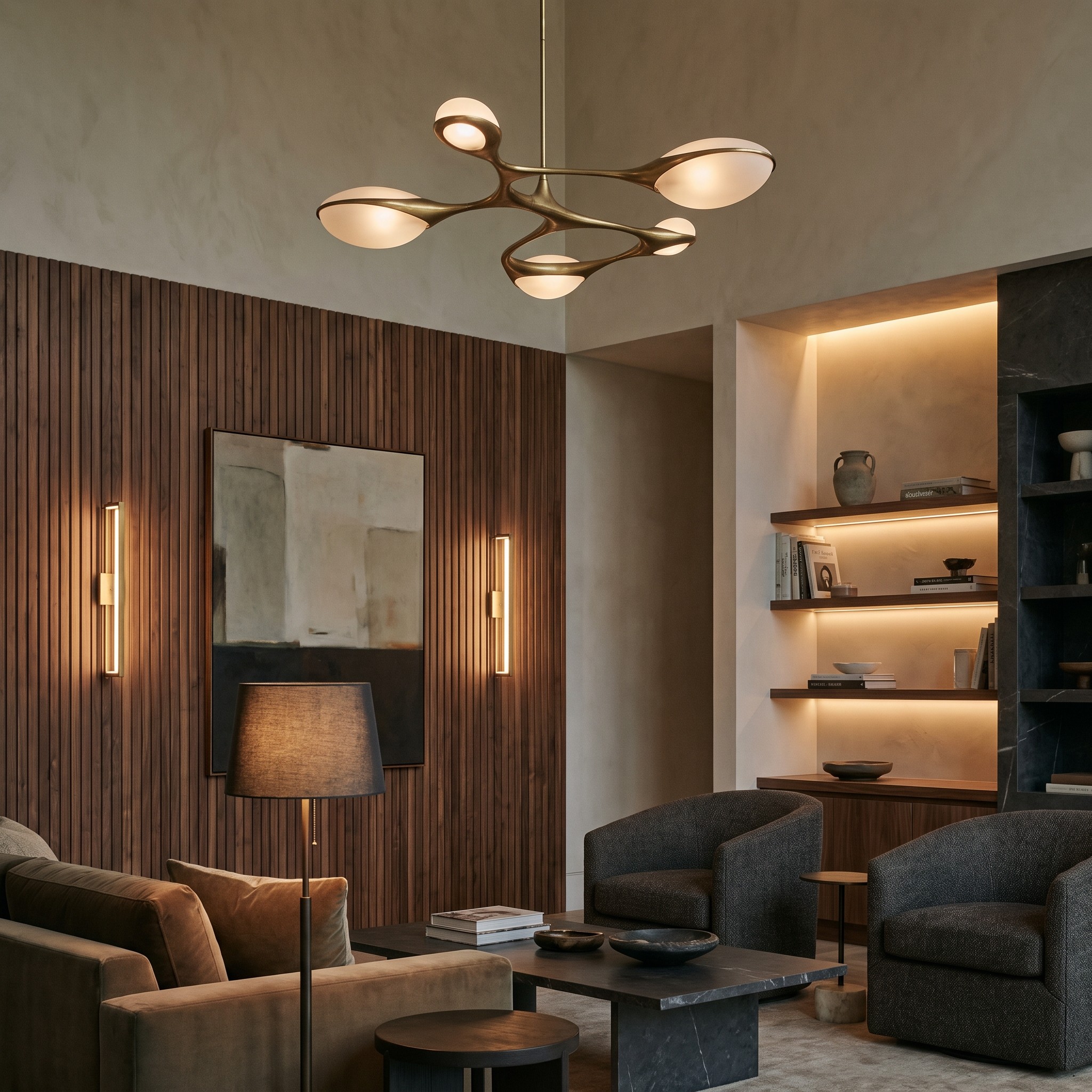
Think in Layers, Not Fixtures
I like to think of lighting almost as painting. Instead of asking, “How many lights does this room need?” consider where you actually want the light to fall.
A decorative chandelier or pendant can act as the jewelry of a room, creating a focal point and drawing the ceiling into the composition. Sconces bring illumination down to a more human scale while becoming part of the architectural rhythm of the walls.
Floor and table lamps create smaller pools of light around furniture, while picture lights can highlight artwork much as they do in a gallery. Cove and perimeter lighting can provide soft ambient illumination without introducing another visible fixture.
Layered together, these sources create depth. There is light above you, beside you, around you, and focused on the things worth seeing.
Recessed Lighting Isn't the Problem
I love recessed lighting. What I don't love is recessed lighting being used as a substitute for thinking about lighting.
A recessed downlight is a useful tool. But it isn't the only tool.
When every lighting problem is solved by adding another can, eventually the ceiling starts looking like a football field. Everything may be illuminated, but the room loses contrast, atmosphere, and hierarchy.
Before adding another fixture, ask what job it needs to perform. Does a dark work surface need task lighting? Does artwork deserve emphasis? Could indirect perimeter lighting illuminate the room more comfortably? Would a floor lamp create a better pool of light beside a chair?
The same principle applies to integrated architectural lighting. Not every shelf, drawer, cabinet, and baseboard needs to glow simply because LED tape exists.
If you're unsure whether a light belongs somewhere, ask why you need it.


Let the Lighting Change
A room doesn't need to feel the same at 10 a.m. and 10 p.m.
On a dark, cloudy day, brighter white light can make an interior feel energetic and active. In the evening, warmer amber light creates an entirely different atmosphere: softer, calmer, and more intimate.
That's why I love dimmers and tunable-white lighting in residential interiors. When possible, different layers should be independently controlled so the room can respond to how you're actually using it.
Turn up the ambient lighting while you're working. Dim the chandelier at dinner. Leave the sconces and lamps glowing later in the evening.
Lighting is one of the easiest ways to completely change the atmosphere of an interior without changing anything else in it.
Let the Room Breathe
We spend enormous amounts of time selecting wood for its grain, stone for its veining, textiles for their texture, artwork for its color, and furniture for its form.
Those decisions deserve to be seen.
That doesn't mean flooding every surface with as much light as possible. It means using illumination intentionally—to reveal texture, create shadows, highlight objects, anchor furniture, and give the architecture depth.
Think about how carefully we light ourselves for a photograph. We adjust the angle, soften the shadows, change the temperature, and pull out the ring light because we understand instinctively that good illumination changes how something looks.
Your living room deserves its ring light too.
Not literally.
But give it the same consideration.
Don't just make the room bright. Paint with light, give every source a purpose, and let the room breathe.
Continue Reading
No items
No items